Background
Diseases are often categorised into stages corresponding to the severity or progression of illness. For example, chronic kidney disease is categorised into five stages corresponding to declining kidney function. Higher stages of chronic kidney disease, and more severely reduced kidney function, are associated with higher mortality. Similarly, cancer is often staged according to spread of the disease, with higher stages defined by regional, nodal and then metastatic spread. Stage migration can occur when a diagnostic modality shifts people into different stages, leading to spurious improvements in outcomes, even when the underlying condition has not changed. Stage migration may also explain changes in the stage-specific incidence over time.
Alvan Feinstein coined the term Will Rogers phenomenon, after the American humourist who apparently said that:
“When the Okies left Oklahoma and went to California they raised the average intelligence in both states”
As the joke goes, although the “Okies” were less intelligent than the average Oklahoman, they were, in fact, cleverer than the average Californian. Their migration to California raised both the average intelligence in Oklahoma and California. A similar effect can occur with stage migration and survival. The figure below illustrates the same phenomenon using disease stages and average survival. The implementation of a new test or new criteria for staging disease leads to patients being diagnosed at more advanced stages. This increases the average stage-specific survival.
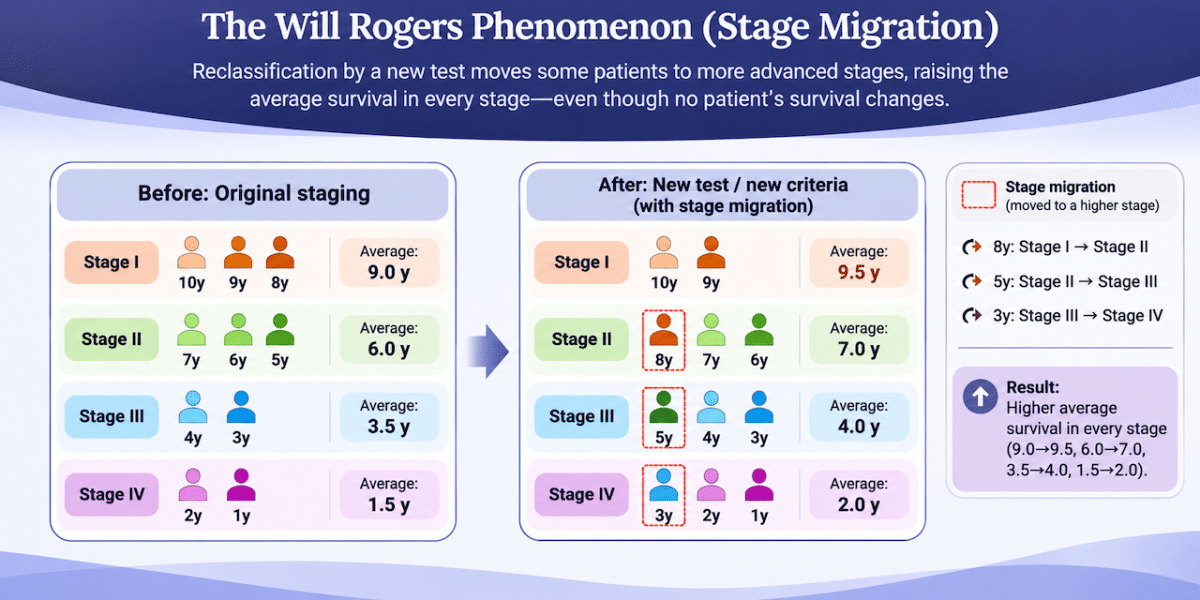
Figure: A hypothetical cohort of 10 patients across four disease stages, with survival time (years [y]) sorted in descending order. Using the new test or new criteria has the effect of migrating patient 8y from stage I to stage II, patient 5y from stage II to stage III, and patient 3y from stage III to stage IV. The migration leads to higher average survival across all stages.
Example
Sormani et al. provide an example of stage migration bias in the diagnosis of multiple sclerosis (MS). In this study, 309 patients were assessed for MS using two diagnostic criteria. Under the old criteria (Poser criteria), 16% of patients were categorised as having MS, whereas using the new criteria (McDonald criteria), 44% of patients were categorised as having MS. The new criteria had the effect of up-staging 28% of patients previously categorised as having ‘no MS’. The effects of the stage migration were an apparent improvement in prognosis. Patients classified as having MS according to Poser criteria had a 46% probability of clinical progression of disease compared with 27% using the McDonald criteria. An improvement in prognosis was also observed in the ‘no MS’ group. The probability of clinical progression was 11% using the Poser criteria and 7% using the McDonald criteria.
Upstaging of MS in this example occurs because the Poser criteria require at least two distinct episodes of neurological dysfunction, whereas the McDonald criteria can be based on clinical signs or on MRI alone. The sensitivity of MRI is thought to be 5 to 10 times greater than that of clinical assessment alone.
Impact
Stage migration bias can lead to an apparent improvement in disease prognosis without any actual change in the underlying disease progression or patient outcomes. This occurs when the introduction of more sensitive diagnostic tests or revised classification criteria results in patients being reclassified into different disease stages or diagnostic categories.
Failure to account for stage migration bias may lead to overestimation of treatment benefits, inaccurate comparisons of survival or disease progression across populations or time periods, and misleading conclusions about the effectiveness of diagnostic and therapeutic interventions.
Preventive steps
Stage migration bias should be considered when comparing measures of prognosis (e.g., survival) across different diagnostic criteria, diagnostic modalities, or over time. Stage migration bias can be mitigated whenever it is possible to ascertain, for each patient, the disease stage across different criteria or diagnostic modalities, as in the example.